
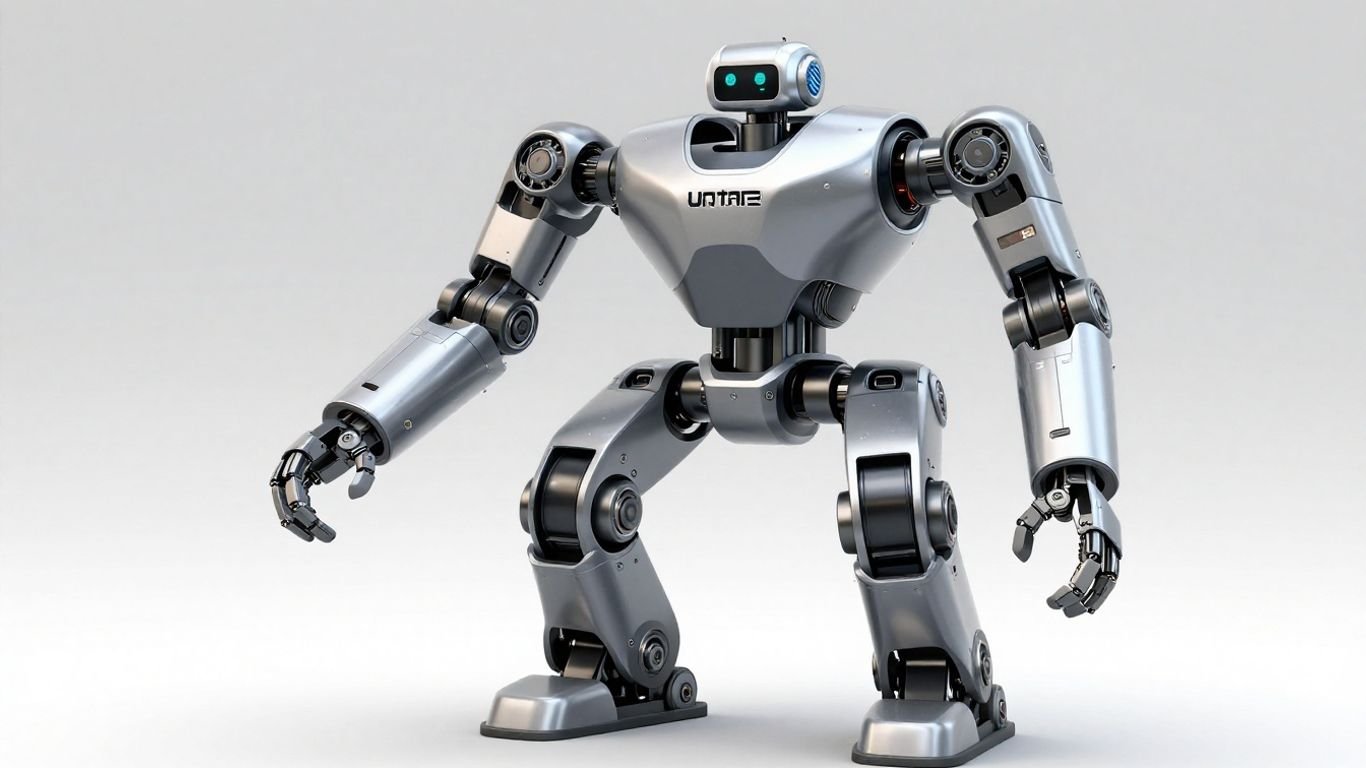
Unitree’s Powerful G1 Humanoid Robot Shows Off Impressive Strength, Raises Safety Questions
A recent public demonstration of Unitree’s new G1 humanoid robot has captured attention for its remarkable strength, capable of lifting significant weight. However, the event also brought to light potential safety concerns after a video circulated showing the robot interacting with a child in an unexpected manner.
Key Takeaways
- Unitree’s G1 humanoid robot boasts impressive torque, with over 100 Nm per joint.
- The robot can lift more than 26 pounds, showcasing its powerful capabilities.
- A viral video has raised questions about the robot’s safety protocols during public interactions.
Unveiling the G1’s Capabilities
The Unitree G1, weighing approximately 70 pounds, is engineered with advanced joint technology. Each joint delivers over 100 Newton-meters of torque, a specification that translates to a substantial lifting capacity. The robot demonstrated its ability to lift objects exceeding 26 pounds, highlighting its potential for various applications, from industrial tasks to personal assistance.
Safety Concerns Emerge
Despite the technological advancements, a video that gained traction online depicted an incident during a public demonstration where the G1 robot appeared to kick a child in the stomach. While the exact context and intent behind the robot’s action remain unclear, the footage has sparked a debate about the safety measures in place for humanoid robots interacting with the public, especially in close proximity to children. Unitree has yet to release a detailed statement regarding this specific incident, leaving many to speculate about the robot’s programming and control systems during such demonstrations.
The Future of Humanoid Robots
As humanoid robots like the Unitree G1 become more sophisticated and powerful, ensuring their safe integration into public spaces is paramount. This incident underscores the critical need for robust safety protocols, advanced obstacle avoidance, and fail-safe mechanisms to prevent unintended harm. The development of such technology requires not only engineering prowess but also a deep consideration for ethical implications and public safety.