
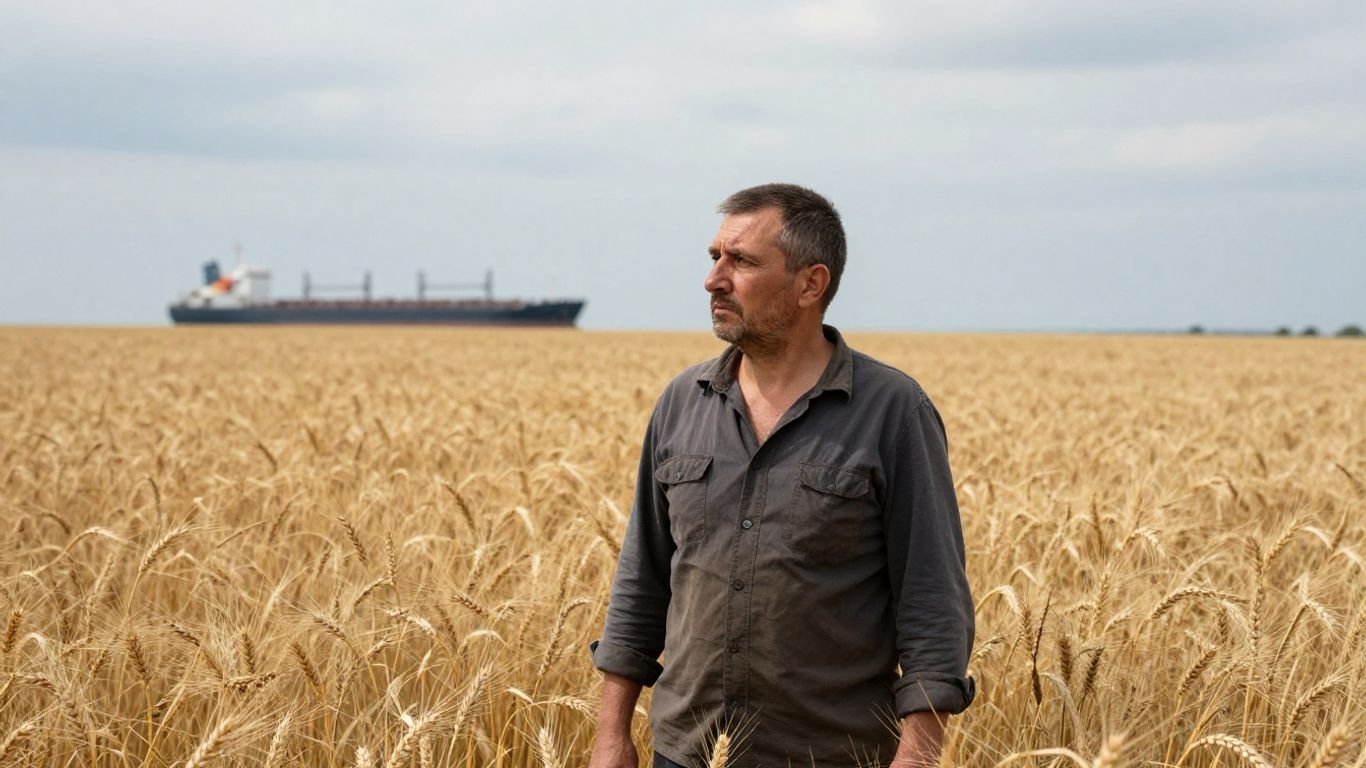
Ukraine’s Farmers Face a Harvest Crisis as Russia’s Black Sea Blockade Tightens
Ukrainian farmers are struggling to move and sell their crops after Russia’s invasion disrupted access to farmland and blocked key Black Sea export routes. For Serhiy Rybalko, the impact has been especially severe: Russia’s occupation of southern territory cost him about two-thirds of his land, leaving his remaining operation exposed to rising costs and uncertain markets.
Key takeaways
- The war has sharply reduced the land available to some Ukrainian farmers.
- Russia’s control and blockade of Black Sea routes have trapped harvests and constrained exports.
- Farmers face mounting financial pressure as storage, transport, and sales become harder.
- The disruption threatens both Ukraine’s rural economy and global food supply chains.
Lost land, disrupted livelihoods
Rybalko’s experience illustrates how the war has transformed farming from a seasonal business into a struggle for survival. The occupation of large areas in southern Ukraine removed productive fields from his control, while the continuing conflict has made it more difficult to plan planting, secure equipment, and protect workers.
For farmers who remain on Ukrainian-controlled land, the loss is not limited to acreage. Fields may be inaccessible, damaged, or located near active fighting. Even when crops are successfully harvested, getting them to buyers can be just as challenging as growing them.
The Black Sea bottleneck
Before the invasion, Ukraine relied heavily on Black Sea ports to export grain and other agricultural products. Russia’s blockade has restricted that flow, forcing producers and traders to seek slower and more expensive alternatives by rail, road, and river.
Those routes cannot always match the volume or efficiency of maritime shipping. Delays can leave crops sitting in storage, limit room for the next harvest, and push up transportation costs. For smaller farms, the financial strain can threaten their ability to continue operating.
Pressure on prices and rural communities
When export channels narrow, farmers can receive less for their crops even as fuel, fertilizer, machinery, and transportation become more expensive. This squeeze leaves producers with fewer resources to invest in the following growing season.
The consequences extend beyond individual farms. Agriculture supports local jobs, processors, transport companies, and communities across Ukraine. Prolonged disruption can weaken rural economies and accelerate the decline of areas already affected by occupation, displacement, and infrastructure damage.
A wider food-security concern
Ukraine is a major agricultural supplier, so interruptions to its exports can affect food availability and prices well beyond the country’s borders. The blockade adds uncertainty to global commodity markets and places particular pressure on import-dependent countries.
For farmers such as Rybalko, however, the issue is immediate and personal: preserving a livelihood while access to land and markets remains uncertain. Their experience shows how military control of territory and trade routes can reshape food production long after a crop is planted.