
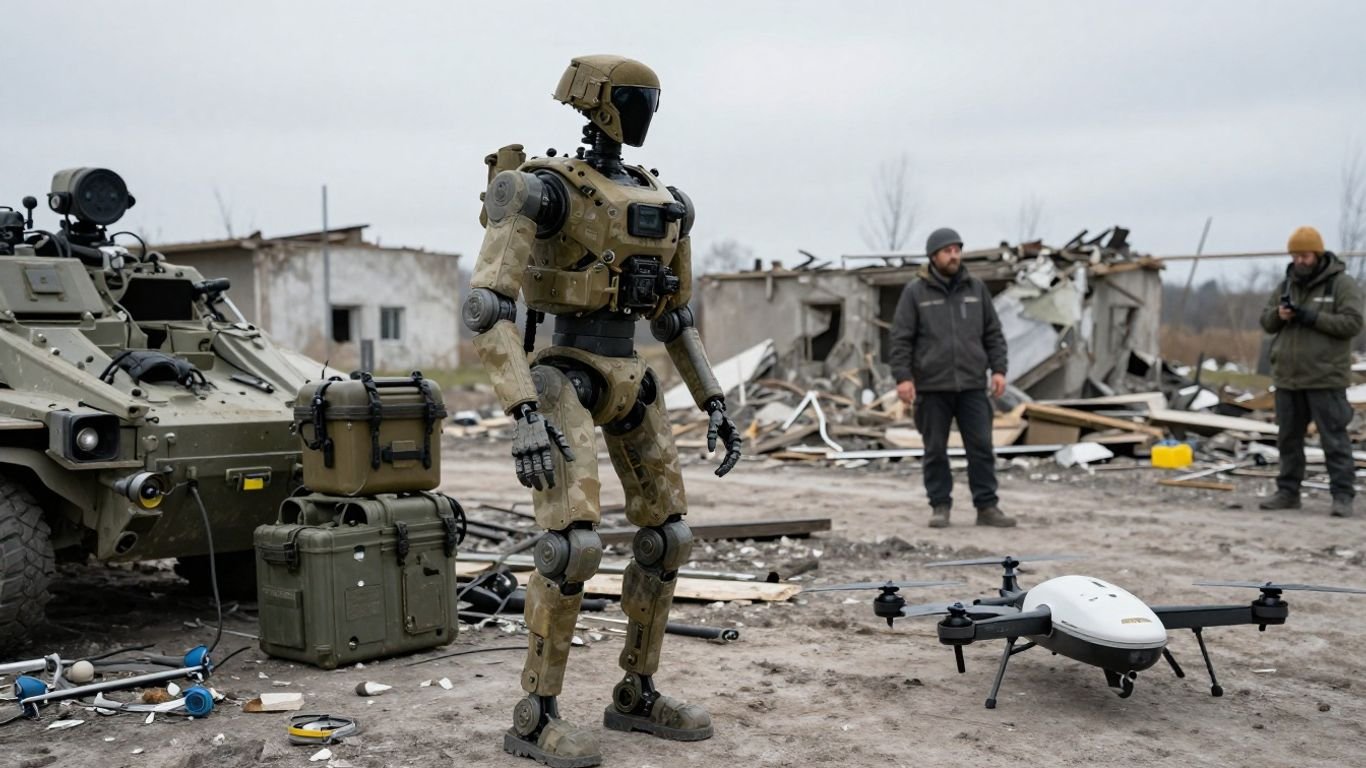
Ukraine Launches Grant Competition to Develop Humanoid Robots for Its Armed Forces
Key Takeaways
Ukraine is opening a grant competition focused on humanoid robots for Ukraine’s armed forces. The program is intended to support domestic defense engineering, reduce soldiers’ exposure to dangerous tasks, and test whether a human-shaped machine has a practical role alongside existing drones and ground systems.
- The competition is centered on defense applications rather than household or commercial robotics.
- Early projects are likely to focus on simpler, useful battlefield tasks.
- Humanoid designs may help in spaces built for people, but they will not replace every drone or vehicle.
- Mobility, batteries, communications, maintenance, and human control remain serious obstacles.
- Public accountability will matter as much as technical ambition.
What Ukraine’s humanoid robot grant competition is designed to achieve
Ukraine’s decision to fund a humanoid-robot competition reflects the pressure of a war in which technology is being developed and tested at unusual speed. The initiative, led by Brave1, is meant to encourage developers to build machines for military use and reduce the risks faced by Ukrainian troops. It also gives the country a way to turn battlefield needs into domestic engineering priorities. The program should therefore be judged by practical results, not by the novelty of a robot’s appearance.
The government’s stated goals for military robotics
The central goal is straightforward: make dangerous military work less dangerous for people. A robot that can carry equipment, inspect a hazardous area, or work near an explosive device could give commanders another option when sending a soldier would be unnecessarily risky. The initiative also fits Ukraine’s broader effort to expand defense technology made by Ukrainian companies. That focus is visible in the humanoid robot grant competition, which describes a staged path from simpler designs toward more advanced capabilities.
A military grant, however, is not the same thing as a fielded weapon. Developers must still show that a system can operate reliably, be repaired close to the front, and provide a clear advantage over equipment already in service. The government’s stated ambition will become meaningful only when prototypes survive realistic trials and produce useful evidence.
Why humanoid robots for Ukraine are attracting attention
Humanoid machines attract attention because they are designed around the proportions and tools of human environments. Doors, stairs, ladders, workbenches, vehicles, and storage areas are generally built for people, not for six-wheeled machines. That does not automatically make two legs the best answer, but it creates a possible niche where a robot can use existing infrastructure without every site being redesigned.
There is also a strategic reason for the interest. Ukraine has already shown how quickly relatively small teams can adapt unmanned systems to urgent battlefield needs. A humanoid program could apply that same problem-solving culture to ground missions where aerial drones cannot safely or precisely perform the work. Practical utility must come first, because a machine that looks futuristic but fails in mud has little military value.
How the grant competition could support domestic defense innovation
A competition can do more than distribute money. It can bring engineers, software developers, mechanics, military users, and manufacturers into the same process, allowing prototypes to be shaped by people who understand actual conditions. Smaller Ukrainian companies may gain an opportunity to test ideas that would otherwise struggle to attract capital or access military feedback.
The best outcome would be a repeatable development pipeline: identify a problem, build a modest prototype, test it with users, document its failures, and improve it. That approach can also strengthen supply chains for motors, sensors, batteries, control systems, and rugged communications equipment. It is less glamorous than announcing an autonomous soldier, but far more likely to produce something useful.
What remains unclear about the program’s funding and timeline
Public descriptions of the competition do not answer every question a developer or taxpayer might ask. The size and structure of grants, the application timetable, testing locations, procurement pathway, and rules for classified information all need to be clear. So does the distinction between a research prototype, a demonstration model, and a system approved for operational use.
Those details will shape the program’s credibility. A short competition can generate attention, but military robotics usually requires extended testing, maintenance planning, and user training. Without a transparent timeline and clear evaluation criteria, the initiative could reward polished demonstrations rather than dependable equipment.
Why Ukraine is pursuing humanoid robots for battlefield operations
The battlefield is a harsh test for any machine, and Ukraine has strong reasons to explore systems that could keep personnel away from exposed positions. Humanoids are not automatically superior to conventional drones or ground vehicles; their value depends on the mission. The most credible early uses are likely to involve hazardous support work, not dramatic visions of robot infantry. This is a question of choosing the right tool for the job.
The case for machines built around human environments
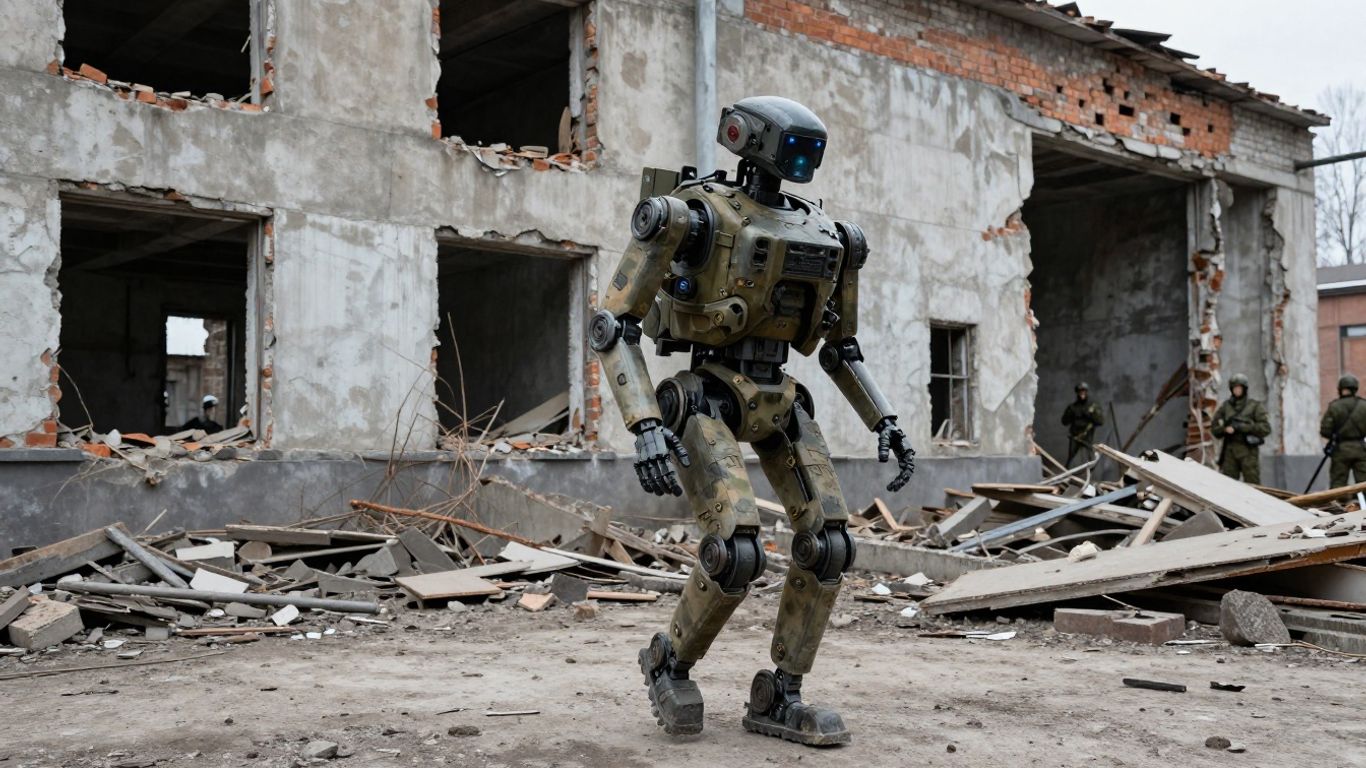
A human-shaped robot could be useful where the environment already assumes a human operator. It may be able to move through a doorway, climb a stairway, pick up an object from the floor, or manipulate equipment designed for a person. In damaged buildings, that flexibility could matter when rubble blocks wheeled platforms or when changing the site for a vehicle would take too much time.
Yet the form has a cost. Two legs require difficult balance control, more actuators, and careful recovery after a stumble. A low, wide platform may be less elegant but more stable and easier to maintain. The case for a humanoid is strongest when its ability to interact with human infrastructure outweighs those disadvantages.
Missions that could reduce soldiers’ exposure to danger
The first missions should be selected for their risk to people and their tolerance for slower performance. Supply pickup, equipment recovery, hazard inspection, and selected reconnaissance tasks are more plausible starting points than independent lethal action. Reporting on military humanoid robotics likewise points to support roles such as supply pickup, reconnaissance, and hazard inspection while noting that early systems remain limited.
This distinction matters morally and operationally. A machine used to inspect a suspicious route can be evaluated against a clear safety objective. A machine given broad authority to use force raises far harder questions about judgment, identification, and responsibility. Ukraine’s grant program will be better served by proving value in narrow missions before expanding the scope of any system.
Logistics, evacuation, reconnaissance, and engineering applications
Ground robots could eventually assist with moving ammunition, water, batteries, medical supplies, or damaged equipment through areas exposed to fire. They might also help inspect collapsed structures, clear access routes, or carry tools for engineers. Evacuation support is another possible role, although lifting and stabilizing an injured person safely is a demanding technical problem.
A useful mission set would combine several modest capabilities rather than promise a universal machine. Developers might prioritize:
- Carrying a defined payload over a short, hazardous route.
- Inspecting rooms, trenches, or damaged infrastructure.
- Retrieving equipment without sending a soldier into exposed ground.
- Performing supervised engineering or clearance tasks.
These tasks still require dependable navigation and careful human supervision. They also need clear procedures for what happens when the robot loses contact, becomes trapped, or encounters a civilian.
Where wheeled, tracked, and aerial drones may still perform better
Humanoids will face competition from simpler machines, even when the program itself is focused on human-shaped designs. Wheels and tracks usually offer better stability, longer endurance, and greater payload efficiency. Aerial drones can reach an area quickly, observe from above, and operate without navigating every obstacle on the ground.
The practical question is not whether humanoids will replace those systems. It is whether they can fill a narrow gap that existing platforms cannot. A ground robot for reconnaissance and supply hauling illustrates why conventional uncrewed vehicles may remain attractive: they can be designed around stability, transport, and human-in-the-loop operation rather than human anatomy.
How humanoid robots could fit into Ukraine’s defense strategy
A humanoid robot would not operate in isolation. Its usefulness would depend on how well it fits Ukraine’s existing command, reconnaissance, logistics, and unmanned-systems networks. The machine would need a clear role, a trained operator, and a recovery plan when conditions exceed its limits. Integration is likely to be more important than appearance.
Operating in buildings, trenches, and damaged infrastructure
Buildings and trenches create a difficult mixture of tight spaces, unstable surfaces, darkness, dust, and uncertain maps. A robot that can use stairs or step over obstacles might reach places that a standard ground platform cannot. But it must also detect weak flooring, avoid entanglement, and remain stable while handling objects.
Military users would need to know the system’s limits before deployment. A robot that can cross a clean test floor may fail in a smoke-filled room with loose debris and poor lighting. Trials should therefore include damaged structures and changing layouts, not just controlled demonstrations.
Carrying supplies through hazardous areas
Supply movement is one of the clearest ways to connect robotics with force protection. Even a short trip through a mined, shelled, or observed area can expose a person to serious danger. A machine that carries a modest load and returns reliably could reduce that exposure, provided its cost and maintenance burden are acceptable.
Payload figures alone would not settle the question. Commanders would also need to consider loading time, route planning, recovery after failure, and whether the robot can be repaired without shipping it far from the unit. A smaller machine that works every day may be more valuable than a stronger prototype that spends most of its time waiting for parts.
Supporting bomb disposal and other high-risk missions
Explosive ordnance disposal demands careful manipulation, stable positioning, and excellent remote feedback. A humanoid could be useful if it can handle tools already used by technicians, but that possibility should not be confused with readiness. Bomb disposal is unforgiving: a small control error or sensor failure can have immediate consequences.
The same caution applies to inspecting contaminated areas, entering unstable buildings, and recovering sensitive equipment. Operators need reliable video, depth information, force feedback where appropriate, and a way to stop motion instantly. Human specialists must retain authority over the mission, even if the robot handles the physical reach.
Connecting robots to Ukraine’s existing drone and battlefield systems
The strongest concept is a coordinated force in which aerial systems provide observation, ground systems move supplies, and human operators decide what happens next. A humanoid might receive a route from a planning system, use information from a drone, and report its own position to a command network. Such integration could reduce duplicate work and help personnel understand the machine’s surroundings.
Data protection must be part of that design from the beginning. A system that collects operational imagery or location information can expose units if its communications are compromised. Guidance on protecting sensitive personal and neural data is not a military standard for robots, but it highlights the broader principle: systems that process sensitive information need explicit limits on collection, sharing, retention, and access.
The technical and operational hurdles developers must overcome
A prototype that walks in a laboratory is only an early demonstration. Front-line conditions add mud, dust, cold, damaged networks, improvised repairs, and operators who may have little time for troubleshooting. Developers must build for failure rather than assume ideal conditions. The central test is whether a system remains useful when several problems occur at once.
Mobility across mud, rubble, snow, and uneven terrain
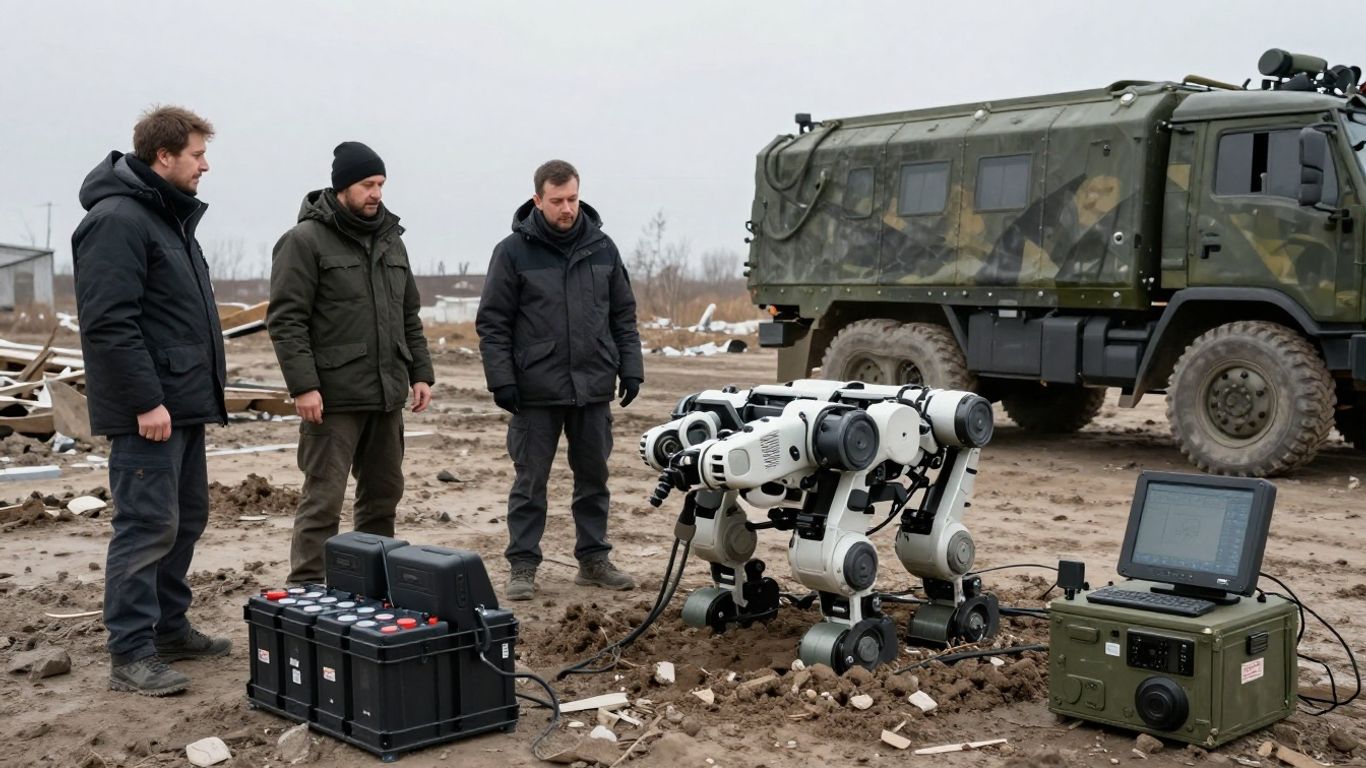
Walking machines must constantly estimate where to place each foot and how much force to apply. Mud can hide holes, rubble can shift under weight, and snow can obscure the ground. A fall may damage sensors or leave the robot unable to stand, turning a mission into a recovery operation.
Testing should include slopes, loose materials, broken concrete, narrow passages, and poor visibility. It should also measure how quickly an operator can regain control after a stumble. A robot’s ability to recover itself may be useful, but it adds complexity and must be proven rather than assumed.
Battery life, payload capacity, and maintenance demands
Power is a basic constraint. Walking consumes energy, carrying a load consumes more, and cold weather can reduce battery performance. Extra batteries add weight, while larger batteries increase cost and may complicate transport and handling.
Developers should report the complete operating picture, not just a maximum runtime under light conditions. Relevant measures include:
| Measure | Why it matters | Field question |
|---|---|---|
| Runtime under load | Determines mission length | Can it complete a round trip? |
| Payload at range | Connects strength with usefulness | What can it carry reliably? |
| Repair time | Affects unit availability | Can technicians restore it quickly? |
| Spare-parts burden | Shapes logistics and cost | What must each unit carry? |
A transparent test report would help commanders compare a humanoid with simpler platforms. It would also discourage impressive but incomplete performance claims.
Communications resilience under jamming and cyberattacks
A remotely supervised robot is only as capable as its connection to the operator. Jamming, interference, damaged relays, and cyberattacks can interrupt video or commands at the worst possible moment. Systems therefore need safe degraded modes, authenticated control, and a predictable response when contact is lost.
Autonomy can help with routine movement, but it does not remove the security problem. An autonomous machine still depends on software, sensors, updates, and data links that may be attacked or misled. Testing should include communications loss and false inputs, with clear records of what the robot did and why.
Keeping humans in control of lethal decisions
The most consequential boundary is the decision to use lethal force. A robot may assist with observation, navigation, or physical tasks, but identifying a target in a crowded and changing environment is a human responsibility that cannot be reduced to a marketing feature. Rules of engagement, operator training, and audit logs must be established before any weapon-related testing.
A defensible program would separate mobility trials from weapons trials and require explicit authorization for any transition between them. It would also preserve a human ability to intervene, cancel an action, and review the system’s behavior afterward. Technical sophistication does not replace accountability.
What the competition means for Ukraine’s defense industry
The grant competition could strengthen Ukraine’s defense industry if it connects ambitious research with procurement realities. Local firms have an opportunity to build expertise in mechanical design, embedded software, sensors, batteries, and secure communications. They also have an opportunity to waste time and money if the program rewards spectacle over usefulness. The difference will depend on evaluation and follow-through.
Creating opportunities for Ukrainian robotics startups
Small companies can often move faster than large contractors, particularly when users need a quick modification. A grant can help them build prototypes, hire specialized staff, and test components that are difficult to finance through ordinary commercial sales. It can also expose weaknesses early, before a product is presented as ready for widespread deployment.
Startups should be encouraged to define a specific operational problem and a measurable test. A narrow system for carrying supplies or inspecting structures may create a stronger foundation than an attempt to solve every battlefield task at once.
Attracting engineers, investors, and international partners
A credible public program can draw talent toward defense engineering and give international partners a clearer route into collaboration. Universities, manufacturers, software teams, and overseas investors may contribute different pieces of the development process. International cooperation could also improve access to components and testing expertise.
That cooperation must remain aligned with Ukraine’s security needs. Foreign funding or technical assistance should not lead to unclear ownership, dependence on fragile suppliers, or restrictions that prevent Ukrainian units from maintaining the equipment themselves.
Protecting intellectual property and sensitive military data
Robotics projects generate valuable information even when the prototype fails. Design files, sensor recordings, terrain data, operator feedback, and test results may reveal both technical methods and battlefield conditions. Companies and the state need agreements that protect legitimate intellectual property without hiding poor performance from military users or the public.
Data governance should cover who can access recordings, how long they are stored, whether they leave Ukraine, and what happens when a contractor changes ownership. The privacy policy guidance available for digital services is not a substitute for defense contracting rules, but it shows why collection and access practices need to be written down rather than left to assumption.
Measuring results instead of rewarding hype
The program should publish a practical scorecard. Useful measures might include mission completion, failure rates, repair times, operator workload, cost per operating hour, and performance under degraded communications. These figures would make it easier to compare humanoids with other forms of unmanned equipment.
The same discipline applies to public communication. Search visibility and online attention can shape how technology is perceived, but an AI in Google search strategy is not evidence that a defense prototype works. Engineers and officials should rely on repeatable field data, not the volume of headlines surrounding a demonstration.
The risks, costs, and accountability questions surrounding the program
Humanoid robotics may offer real protection for soldiers, but development is expensive and failure can carry serious consequences. Public money must be directed toward missions with a credible operational payoff. The program also needs safeguards for civilians, soldiers, operators, and the communities where testing occurs. Enthusiasm should not be allowed to outrun responsibility.
Whether humanoid robots can justify their development expense
A humanoid robot includes many costly systems: actuators, batteries, sensors, control software, protective housing, training tools, and spare parts. Its price must be compared with the full cost of alternatives, including the people required to operate and repair each platform. A machine that is technically impressive may still be a poor procurement choice if a simpler system performs the same task more cheaply.
The right comparison is mission-based. If a humanoid can safely perform a task that would otherwise expose several soldiers to danger, its cost may be justified. That claim must be supported by trials, not by a general belief that advanced technology is inherently worthwhile.
Preventing misuse, accidents, and civilian harm
Robots can create new hazards if they malfunction, are captured, or are used outside their approved mission. A machine moving through a populated area must distinguish between obstacles and people, and operators must understand what its sensors can and cannot detect. Clear markings, restricted operating zones, emergency stops, and incident reporting are basic protections.
Cybersecurity is also a safety issue. Unauthorized access could redirect a robot, expose reconnaissance data, or cause panic among civilians. Every deployment should have a recovery plan, a chain of command, and a process for investigating mistakes without concealing them.
Establishing procurement standards and battlefield testing rules
The competition needs rules that separate experimentation from operational deployment. Developers should document software versions, component changes, test conditions, and known limitations. Military units should record failures and near misses, while independent reviewers should be able to examine whether reported results match the evidence.
Standards should address physical safety, communications, data handling, maintenance, operator certification, and human control. Testing near civilians or active combat must require additional authorization. A clear process protects both the public and the developers whose systems need honest evaluation.
Ensuring taxpayers and soldiers benefit from the investment
The program’s ultimate test is whether it improves the position of Ukrainian personnel without creating an unmanageable burden. Soldiers need equipment they can understand, trust, repair, and abandon safely if necessary. Taxpayers need evidence that grants are distributed fairly and that successful prototypes can move through procurement without political favoritism.
That means publishing what can safely be published: selection criteria, broad funding totals, test categories, and lessons from failed projects. A transparent process will not remove every risk, but it can prevent secrecy and excitement from becoming substitutes for results.
Conclusion
Ukraine’s humanoid robot grant competition is a serious experiment in matching emerging technology with battlefield needs. Humanoid robots may eventually help with logistics, reconnaissance, engineering, and other dangerous tasks, especially in spaces built for people. But their future will depend on reliability, affordability, secure communications, careful testing, and firm human control. The strongest program will be the one that protects soldiers while remaining honest about what the machines cannot yet do.
Frequently Asked Questions
What is Ukraine’s humanoid robot grant competition?
It is a defense-focused initiative intended to support the development of humanoid robots for Ukraine’s armed forces, beginning with practical prototypes and progressively more advanced capabilities.
Why is Ukraine interested in humanoid robots?
Humanoid robots could potentially operate in buildings, trenches, and damaged infrastructure designed around human movement, while taking on some hazardous tasks currently assigned to soldiers.
Will humanoid robots replace drones?
Probably not. Aerial, wheeled, and tracked drones may remain cheaper, more stable, faster, or better suited to many missions. Humanoids would need to fill a specific gap.
What missions could humanoid robots perform?
Possible missions include carrying supplies, inspecting hazardous areas, recovering equipment, supporting engineering work, assisting reconnaissance, and eventually helping with other carefully supervised high-risk tasks.
What are the biggest technical challenges?
Major challenges include balance on uneven ground, battery endurance, payload capacity, exposure to dust and weather, maintenance, reliable communications, and safe operation after a system failure.
Would these robots carry weapons?
The grant program is focused on military applications, but any weapon-related use would raise additional legal, ethical, and operational requirements. Human authorization and control over lethal decisions would be essential.
How should success be measured?
Success should be measured through repeatable field tests covering mission completion, reliability, repair time, operator workload, cost, communications resilience, and safety rather than through demonstrations alone.