
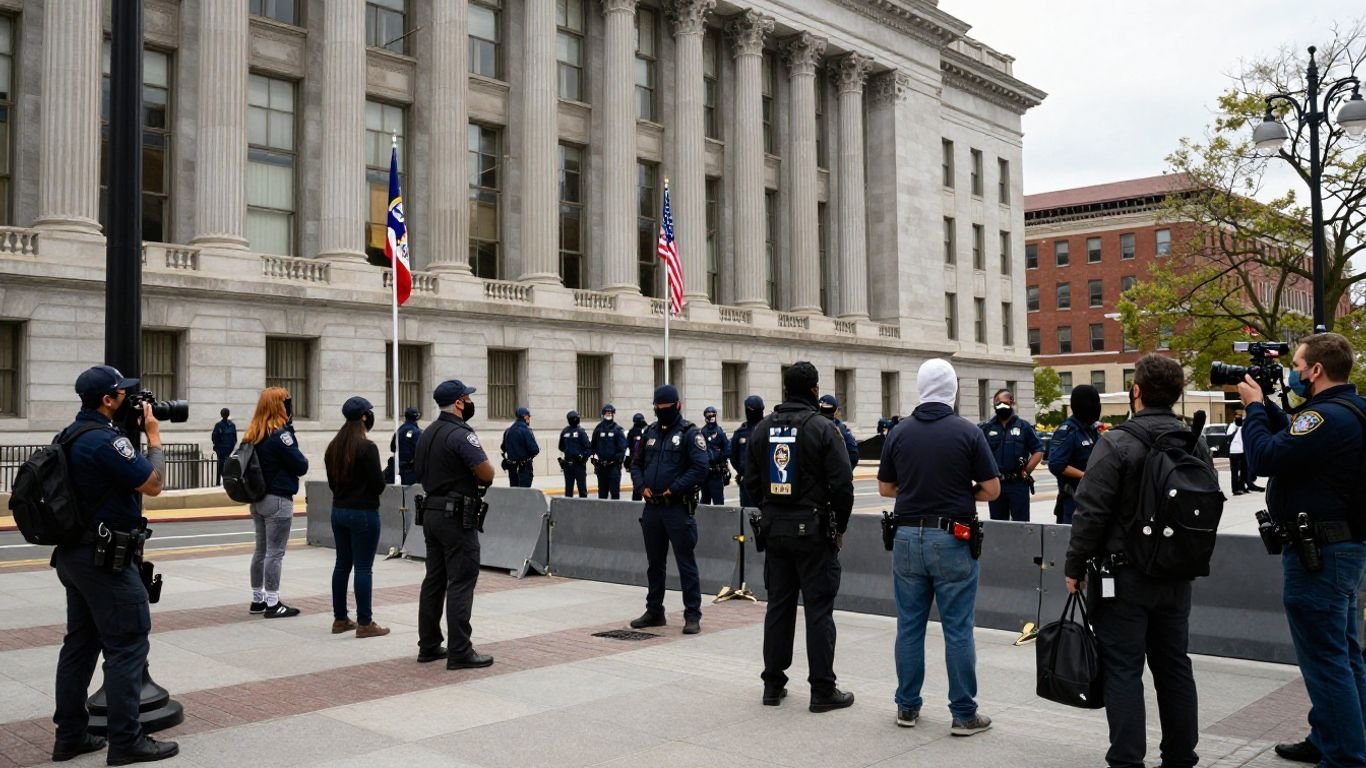
What Is Patriot Front? Origins, Ideology, Activities, and Controversies
Key Takeaways
Patriot Front is a white nationalist organization that emerged from the American Vanguard movement after the 2017 Charlottesville rally. Its carefully managed public image, nationalist symbolism, and recurring demonstrations have drawn attention well beyond its relatively opaque membership base.
- Patriot Front was founded in 2017 by Thomas Rousseau after a split within American Vanguard.
- The organization promotes white ethnonationalism and rejects multiculturalism and immigration.
- Members rely heavily on anonymity, coordinated visuals, online recruitment, and propaganda.
- Demonstrations, arrests, lawsuits, and intimidation allegations have shaped public criticism.
- Visibility does not necessarily equal broad support, durable political power, or verified membership strength.
How Patriot Front emerged from the American Vanguard movement
Patriot Front developed from the factional disputes and ideological currents surrounding the American alt-right in 2017. Its emergence followed the Unite the Right rally in Charlottesville, Virginia, where white nationalist groups gathered amid violent clashes and the death of counter-protester Heather Heyer. The organization that followed sought to present a more disciplined and visually consistent version of white nationalism. That rebranding did not remove the movement from the extremist tradition in which it began.
The 2017 Charlottesville rally and the split within American Vanguard
American Vanguard was one of the groups present at the Charlottesville rally, and Thomas Rousseau was associated with its contingent. After the event, disputes over leadership, strategy, and public presentation contributed to a break. Rousseau announced a new organization, Patriot Front, while the wider movement faced intense scrutiny over its rhetoric and connections. Contemporary backgrounders describe the group as a splinter from Vanguard America after the rally; readers can compare that account with this Patriot Front backgrounder.
The split mattered because Charlottesville made organizational branding a practical concern. Participants could no longer rely on obscure online identities alone: photographs, lawsuits, public records, and investigative reporting had made the movement easier to track. Patriot Front responded with a name and visual language designed to appear orderly, patriotic, and tightly controlled, even as its underlying racial politics remained extreme.
Thomas Rousseau’s role in founding and leading the organization
Thomas Rousseau is widely identified in research and reporting as Patriot Front’s founder and central leader. Before creating the group, he had participated in Vanguard America and the broader white-power movement. His leadership helped give Patriot Front a consistent structure, set of symbols, and communications style. Because members generally conceal their faces and identities, Rousseau’s visible role also provides one of the few relatively stable reference points for understanding the organization.
Leadership in a secretive movement is not the same as transparent institutional authority. Public information about internal decision-making, membership numbers, and local chapters is limited. That makes it wise to distinguish documented leadership activity from claims about the group’s reach or control over every action attributed to people associated with it.
Rebranding, recruitment, and the use of a new public image
The Patriot Front name represented more than a change in stationery. It accompanied a deliberate effort to replace the chaotic, openly confrontational image associated with parts of the alt-right with uniforms, coordinated marches, polished video, and patriotic imagery. The effect was a message of discipline and belonging aimed at potential recruits who might be drawn to nationalist politics but wary of public disorder.
That presentation can obscure the content beneath it. Researchers and journalists have continued to classify the organization as white nationalist or white supremacist because of its stated racial hierarchy, hostility to immigration and diversity, and vision of a white ethnostate. A polished aesthetic may make a movement easier to market, but it does not make the underlying ideology moderate.
The group’s development in the post-Charlottesville political environment
After 2017, Patriot Front operated in an environment where extremist groups could reach audiences without building conventional political parties or holding large public meetings. Online channels allowed organizers to circulate graphics, recruit privately, and coordinate local actions. Small groups could also create national visibility through synchronized appearances in several cities.
Its development therefore combined old-style street activism with newer digital distribution. The organization’s public actions were often brief and controlled, while its broader message traveled through recordings, photographs, stickers, and social-media reposts. This combination made the group appear larger and more active than outsiders could easily verify.
What Patriot Front believes and advocates
Patriot Front’s ideology is rooted in white nationalism and an exclusionary conception of American identity. It presents the country as belonging primarily to people of European descent and treats racial and cultural pluralism as a threat rather than a defining feature of the United States. Its rhetoric often uses language about heritage, ancestry, and national renewal, but those themes are tied to a racial hierarchy. A useful overview of Patriot Front’s ideology describes the organization’s hostility toward several minority groups and its goal of an exclusively white America.
Ethnonationalism, national identity, and views on citizenship
Ethnonationalism places ancestry at the center of political membership. For Patriot Front, national identity is not simply a civic commitment expressed through citizenship, law, or shared institutions; it is connected to a particular racial and cultural inheritance. This approach conflicts with the constitutional ideal that political rights do not depend on belonging to a preferred ethnic group.
The organization’s language can sound like conventional patriotism when separated from its wider program. Flags, references to American history, and claims of national restoration are familiar symbols. Their meaning changes, however, when paired with demands for racial homogeneity and exclusionary citizenship.
Immigration, demographic change, and racial politics
Patriot Front opposes immigration and frames demographic change as a danger to white Americans. Its messaging has also echoed replacement-style conspiracy theories, which portray immigration and population change as the result of a deliberate plot. Such claims are unsupported and have appeared across extremist movements as a way to turn social anxiety into racial grievance.
The issue is not merely a harder position on border policy. The organization’s broader argument assigns unequal value to people based on race and ancestry. That is why researchers place its immigration rhetoric within white nationalist politics rather than treating it as an ordinary policy disagreement.
Opposition to liberalism, multiculturalism, and the political establishment
The group rejects liberal democracy, multiculturalism, and what it describes as a corrupt or globalist political establishment. Its proposed alternative is not a conventional conservative administration but a more authoritarian and racially defined state. This distinction matters: criticism of government institutions is common in American politics, while advocating a racially exclusive political order is an extremist project.
Patriot Front’s propaganda often combines anti-establishment language with imagery drawn from older American traditions. The combination may attract people who feel alienated from mainstream institutions, but the movement’s proposed solution remains fundamentally exclusionary. National frustration is being redirected toward minorities, immigrants, and pluralistic democracy.
The tension between public messaging and extremist classifications
Patriot Front often uses restrained language in public-facing materials, which can make its message appear less explicit than that of older neo-Nazi groups. Watchdogs and researchers assess the organization by examining its broader body of statements, recruitment material, symbols, demonstrations, and stated goals. On that record, classifications such as white nationalist, white supremacist, and fascist are used to describe its political program.
The gap between presentation and classification is central to understanding the group. As one research summary of the organization explains, propaganda and marches are not separate from ideology; they are ways of distributing it. A calmer tone changes the packaging, not necessarily the substance.
How Patriot Front organizes and communicates
Patriot Front’s organization is built around controlled visibility and limited personal exposure. Members frequently appear masked, while local activity is coordinated through online channels and small networks. This arrangement protects identities, creates a uniform public image, and makes independent verification difficult. It also leaves outsiders with a partial view of who makes decisions and how many people are actively involved.
Decentralized chapters, leadership, and member anonymity
The group has operated through regional or local chapters connected by central direction and shared branding. Members may take part in local organizing while following national standards for clothing, symbols, messaging, and demonstrations. Anonymity reduces the immediate personal cost of participation, though it does not prevent journalists, researchers, or law enforcement from identifying individuals through digital records and investigations.
The structure offers flexibility but also creates vulnerabilities. Local groups can act quickly, yet a centralized ideological culture may still shape their choices. Public claims about a large nationwide network should therefore be treated cautiously unless supported by membership records, court documents, or independently verified activity.
Recruitment through online platforms and private communications
Recruitment has relied on websites, social-media posts, encrypted or private communications, and downloadable propaganda. Public material attracts attention, while private channels allow organizers to screen applicants and discuss logistics away from open scrutiny. This blend of public promotion and private vetting is common among movements that want reach without surrendering control.
Digital recruitment also helps turn casual interest into practical participation. A person may first encounter a sticker or video, then be directed toward a private discussion or local action. That pathway makes online visibility an important part of the organization’s operating model, even when public attendance remains small.
Use of masks, uniforms, symbols, and coordinated demonstrations
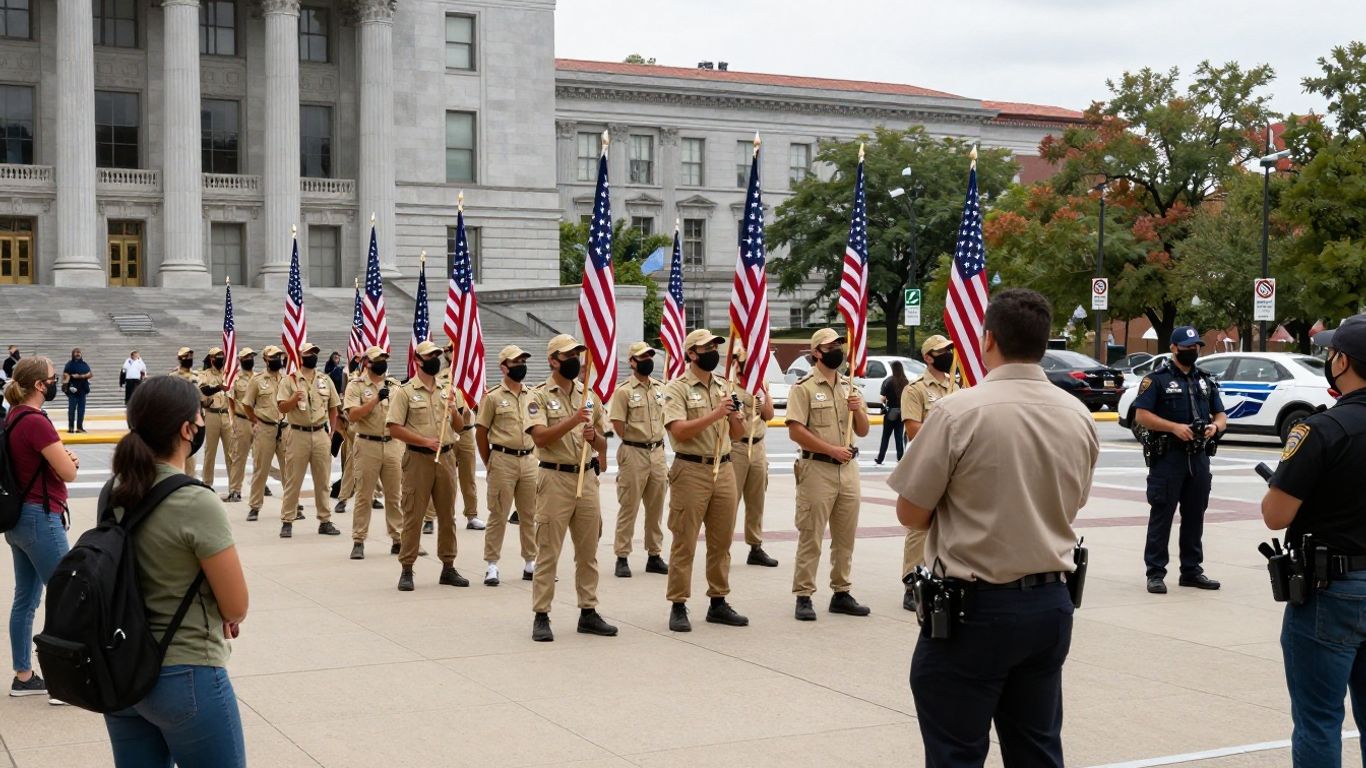
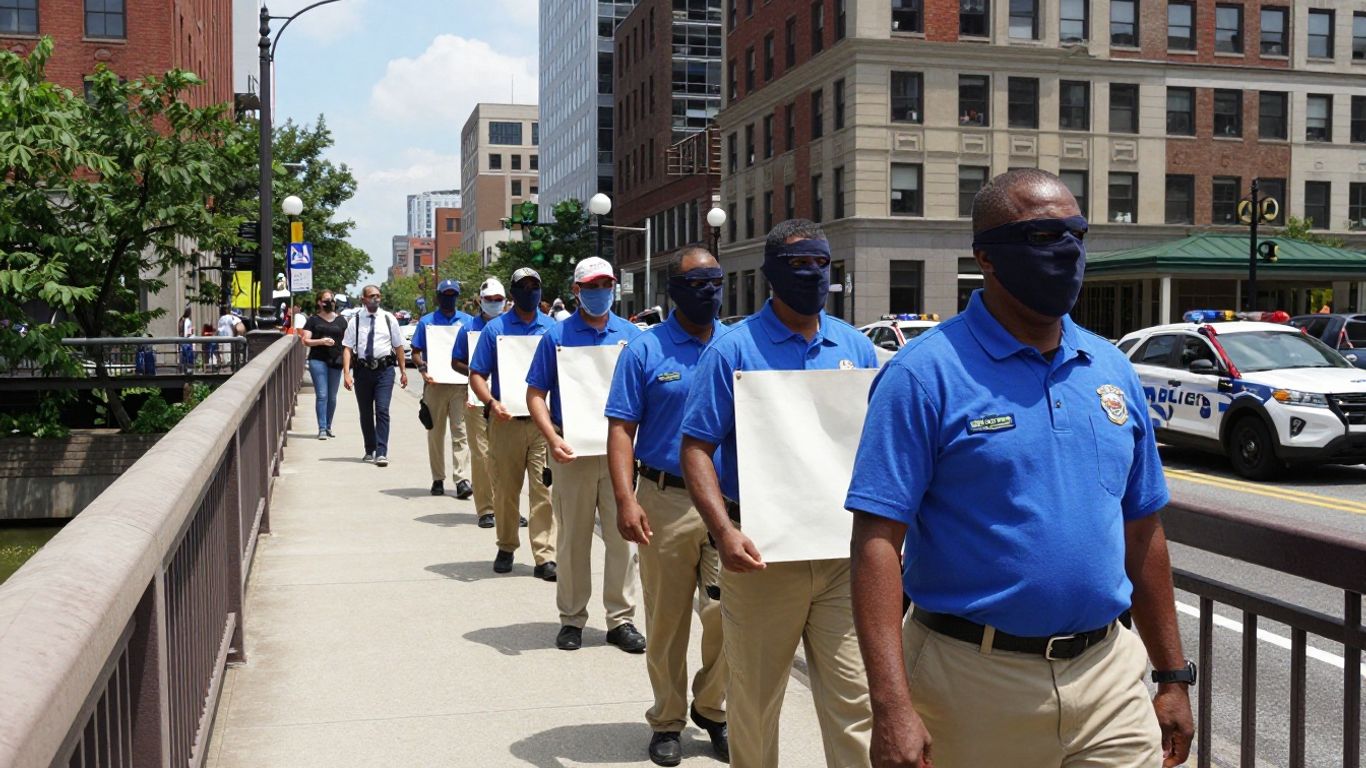
Masks and matching clothing make individual members appear interchangeable and give demonstrations a military or paramilitary visual quality. Khaki clothing, blue shirts, face coverings, flags, and standardized patches have appeared in public actions. The uniformity communicates discipline while making it harder for bystanders to identify participants.
The symbolism is designed for cameras as much as for people at the scene. A coordinated formation can produce striking photographs, short clips, and headlines even when the event is brief. That visual economy is one reason the organization can generate attention disproportionate to the number of people physically present.
Propaganda, video production, stickers, banners, and other messaging tools
Patriot Front has used flyers, posters, stickers, banners, videos, and online graphics to repeat a small set of themes: racial belonging, national decline, immigration, and cultural threat. The material is usually standardized, allowing an image created in one region to be recognized elsewhere. Its purpose is not only persuasion; it is also evidence of activity for existing members and potential recruits.
The messaging becomes easier to assess when each format is treated as part of one campaign rather than as an isolated incident. A banner drop, a video of a march, and a sticker placed in a public area may all serve the same cycle of attention. Researchers must still verify who produced each item before attributing it to the organization.
Patriot Front’s activities in the United States
Patriot Front has been associated with short marches, banner displays, public propaganda distribution, and recruitment-oriented appearances in multiple parts of the United States. These actions are generally planned for visibility and carried out with a controlled number of participants. They can unsettle local communities even when they do not lead to physical violence. The documented pattern of white nationalist flash demonstrations helps place these events in a wider context.
Marches, demonstrations, and banner drops
Marches and banner drops are among the organization’s most recognizable activities. Members may gather on bridges, near civic buildings, or in public areas, hold flags or banners, and leave before a large counter-demonstration can form. The brevity is part of the strategy: it limits exposure while producing images that can be circulated nationally.
Such events are sometimes presented by supporters as orderly political expression. That description addresses conduct at a particular moment, not the group’s whole ideology or record. Free-speech protections apply broadly, but they do not require the public to ignore the racial program being promoted.
Recruitment campaigns at colleges, public spaces, and community events
Recruitment campaigns have included leafleting near colleges, placing stickers in public spaces, and appearing around community events. These settings offer access to people who may not seek out extremist material online. They also create the possibility of confrontation, especially when propaganda is placed in neighborhoods or on sites associated with minority communities.
The goal is often less to persuade a large crowd than to identify a small number of receptive individuals. Public material acts as a signal: it tells sympathizers that an organized network exists and gives them a path toward contact. The resulting visibility should not be confused with broad public approval.
Flyers, posters, stickers, and other local organizing efforts
Printed propaganda remains useful because it is inexpensive, portable, and difficult to measure after distribution. Flyers and stickers can appear overnight, prompting local concern and media coverage even when organizers are gone. Posters and banners similarly extend the life of a short action by leaving a physical trace.
A careful account separates confirmed distribution from assumptions about its scale. Investigators may document a specific location or campaign, but estimates of national output can depend on incomplete reporting. The physical material is visible; the people behind it are often not.
Fundraising, training, and preparation for public actions
Public demonstrations require money, transport, clothing, printing, communications, and planning. Patriot Front’s activities have therefore included fundraising and preparation, although the details of its finances and internal training are not fully public. Members have also appeared to rehearse formations and coordinated movement before demonstrations.
Preparation can make a small group look highly organized, but it does not establish the size of its base. A well-produced event may reflect concentrated effort by a limited number of people. That is a useful reminder when evaluating online videos and promotional imagery.
A simple way to read the organization’s activity is to separate what observers can see from what remains uncertain:
| Observable activity | Likely purpose | What it does not prove |
|---|---|---|
| Coordinated march | Create visual publicity | Broad popular support |
| Flyers and stickers | Reach potential recruits | A verified national membership |
| Masks and uniforms | Protect identity and project discipline | Absence of internal disputes |
| Online videos | Extend the life of an action | Independent journalistic credibility |
The table shows why publicity should be treated as evidence of communication, not automatically as evidence of political strength. The same action can be real, organized, and troubling without demonstrating that the group is representative of ordinary Americans.
Major controversies and public criticism
Patriot Front has faced sustained criticism from civil rights organizations, researchers, local officials, and journalists. Allegations have involved intimidation, property damage, unlawful assembly, and the use of public events to create fear. Some incidents have resulted in arrests or civil litigation, while other claims remain disputed or unproven. Responsible reporting requires keeping those categories separate.
The 2022 Coeur d’Alene demonstration and conspiracy-to-riot charges
In June 2022, police in Coeur d’Alene, Idaho, stopped a U-Haul containing Patriot Front members who had traveled to the city for a planned demonstration. The men were charged with conspiracy to riot, and the case drew national attention because authorities said the group appeared prepared for coordinated disorder. The charges were later dismissed after prosecutors said they could not proceed under the available evidence.
The episode remains significant, but dismissal matters. It is inaccurate to describe the charges as a conviction, just as it would be incomplete to omit the arrest and the authorities’ stated concerns. The incident illustrates how quickly a planned demonstration can become a legal and public-relations crisis.
Arrests, lawsuits, and allegations involving members
Members or alleged members have faced arrests and civil lawsuits connected to demonstrations and acts of vandalism. One widely discussed case involved damage to a mural honoring Arthur Ashe in Richmond, Virginia. Court records and reporting can establish what was alleged, who was named, and what outcome followed; they cannot automatically prove every broader claim made online.
Civil litigation can also expose internal information through discovery, including names, communications, and organizational practices. At the same time, a lawsuit is an accusation until resolved. Readers should consult original filings and final judgments where available rather than treating every headline as a finding of fact.
Claims that the group relies on intimidation and staged publicity
Critics argue that masks, formations, surprise appearances, and carefully timed video releases are intended to intimidate communities while maximizing media attention. The visual choreography can make a small event feel like a show of force. A related analysis of the group’s public image describes the concern that orderly appearances may conceal a more threatening private agenda.
The claim of staged publicity does not mean an event is fabricated. Demonstrations can be genuinely organized and still be designed for cameras. The practical question is what the event communicates, whom it targets, and whether its message encourages fear or hostility toward protected groups.
Criticism from civil rights organizations, researchers, and local officials
Civil rights groups have condemned Patriot Front’s racial ideology and warned about the effects of its propaganda on targeted communities. Researchers track its activity because the organization has been unusually consistent in producing and distributing material. Local officials, meanwhile, must balance public safety, constitutional rights, and residents’ concerns when demonstrations occur.
Those perspectives do not all carry the same evidentiary weight. A police report addresses an incident, a lawsuit addresses legal claims, and a research report may assess patterns across years. Reading them together gives a fuller picture than relying on a single viral photograph or partisan reaction.
How Patriot Front is classified and assessed
Most major extremism researchers classify Patriot Front as a white nationalist or white supremacist organization. These classifications are based on ideology, propaganda, recruitment material, and observed conduct rather than on whether members describe themselves as patriotic. The labels are analytical categories used to identify racial hierarchy and exclusionary political goals. They should be explained rather than used as substitutes for evidence.
Extremism designations from watchdogs and research organizations
Watchdog organizations commonly identify Patriot Front as a white nationalist, white supremacist, or fascist group. Their assessments point to the organization’s advocacy of a white ethnostate, rejection of multiculturalism, anti-immigration messaging, and hostility toward minority communities. These findings are broadly consistent across several research summaries, though wording and emphasis may differ.
Classification does not imply that every allegation is true or that every participant has identical beliefs. It describes the organization’s core political program. That distinction allows readers to take the ideology seriously without abandoning standards of proof.
What journalists and law enforcement reports say about the group
Journalists have documented the group’s demonstrations, propaganda campaigns, recruitment material, and attempts to conceal members’ identities. Law enforcement reports add incident-specific information about arrests, planned events, and investigations. Neither source type is perfect, but together they can establish a timeline and identify points of disagreement.
Reporting also shows why appearances can mislead. A peaceful action on a particular day may coexist with a broader ideology that is hostile and exclusionary. Conversely, a disturbing allegation still requires corroboration before it should be presented as established fact.
Distinguishing documented conduct from allegations and speculation
A sound assessment uses careful verbs and clear sourcing. “Members were arrested” is different from “members were convicted,” and “a lawsuit alleged vandalism” is different from “the organization was found liable.” The difference may feel technical, but it protects readers from both exaggeration and minimization.
This discipline is useful beyond extremist reporting. For example, readers evaluating public claims about safety may consult Clare’s Law, which concerns disclosure of a partner’s history of domestic abuse in the United Kingdom, but that framework is not evidence about Patriot Front. Separating unrelated information from relevant evidence is part of responsible research.
Why membership estimates and organizational strength are difficult to verify
Masks, pseudonyms, private channels, and fluctuating participation make membership difficult to count. A person may download propaganda without attending an event, attend once without joining, or appear in a photograph without holding a leadership role. Conversely, one individual may appear in several regional actions, making a network look larger than it is.
Researchers therefore rely on multiple indicators: public events, leaked records, court documents, online activity, and local reporting. None provides a complete census. Claims about hundreds or thousands of committed members should be treated cautiously unless supported by transparent methodology.
Patriot Front’s influence, limits, and broader significance
Patriot Front’s importance is best measured through the interaction of visibility, ideology, and public response. It has managed to keep its name in circulation through repeated actions and disciplined media production. That does not mean it speaks for a large portion of the public or that its program has moved into mainstream government. Its broader significance lies partly in how extremist movements adapt their presentation to a media environment shaped by short videos and viral images.
The role of social media visibility in measuring influence
Social-media reach can show that content traveled, but it cannot reveal how many viewers agreed with it. Outrage, curiosity, mockery, and news coverage may all increase a post’s circulation. A photograph of masked marchers can therefore create an impression of momentum without demonstrating durable recruitment.
The same caution applies to websites and digital tools. An article about Focused Mental Education, for instance, concerns evidence-based mental-health education rather than extremism; its inclusion here would not establish anything about Patriot Front. The broader lesson is simple: a link, view count, or searchable name is not by itself a measure of political influence.
Internal discipline, anonymity, and the risks of infiltration
Anonymity protects members from immediate consequences, but it also creates trust problems. Leaders must screen recruits, control leaks, and manage the possibility that journalists, activists, or law enforcement may enter private spaces. Internal discipline can reduce public mistakes while increasing suspicion inside the group.
Secrecy also complicates accountability. When participants conceal their faces and communicate through aliases, victims and investigators may need extensive digital or legal work to connect an individual to a public act. The result is an organization that can look orderly from the outside while remaining difficult to audit from within.
Comparisons with other American white nationalist organizations
Patriot Front shares themes with other American white nationalist organizations, including racial hierarchy, anti-immigration politics, hostility to multiculturalism, and an interest in public spectacle. Its distinctive feature is the consistency of its branding and the degree to which it has emphasized choreographed demonstrations. Comparisons are most useful when they identify actual similarities without erasing differences in structure, tactics, or stated goals.
It is also worth avoiding a false choice between “old-fashioned” extremism and modern digital activism. Patriot Front combines traditional street propaganda with online coordination. That hybrid approach is now a recurring pattern among groups seeking both secrecy and public recognition.
Whether public demonstrations translate into lasting political power
Public demonstrations can recruit a few people, intimidate targeted communities, and attract coverage, but they rarely translate automatically into electoral power or broad legitimacy. Lasting influence would require durable institutions, sustained participation, and acceptance beyond a committed fringe. Patriot Front’s secrecy and racial exclusivity make that expansion difficult.
Its activities still matter because political impact is not limited to winning office. A small organization can normalize hateful language, frighten residents, or encourage copycat propaganda. The appropriate response is neither panic nor dismissal, but close documentation, lawful enforcement, and clear rejection of racial supremacy.
A practical review of online material can include a few basic checks:
- Identify whether the claim comes from a primary document or a repost.
- Separate an arrest, allegation, charge, conviction, and dismissal.
- Check the date, location, and identity of people shown in images.
- Compare membership claims with independently documented activity.
These checks slow down the rush from dramatic image to sweeping conclusion. They also help readers avoid amplifying extremist publicity while still recognizing the real harm that intimidation and hate propaganda can cause.
Conclusion
Patriot Front emerged from the post-Charlottesville white nationalist movement and built a recognizable public style around anonymity, uniforms, propaganda, and coordinated demonstrations. Its polished presentation should not obscure its exclusionary ideology or the controversies surrounding its activities. Understanding the organization requires both moral clarity about racial supremacy and factual care about what has been documented, alleged, or left uncertain.
Frequently Asked Questions
What is Patriot Front?
Patriot Front is an American white nationalist organization founded in 2017 after a split within the American Vanguard movement. It promotes an exclusionary vision of national identity centered on white ancestry.
When was Patriot Front founded?
The organization was founded in 2017, following the Unite the Right rally in Charlottesville, Virginia. Thomas Rousseau is generally identified as its founder and leader.
What ideology does Patriot Front promote?
Its ideology promotes white ethnonationalism, opposition to multiculturalism and immigration, and the creation of a racially homogeneous state. Researchers commonly classify it as white nationalist or white supremacist.
Why do members wear masks?
Masks protect members’ identities and create a uniform visual appearance. They also make public demonstrations harder to attribute to specific individuals without further investigation.
What kinds of activities has the group organized?
Reported activities include marches, banner drops, flyer and sticker distribution, online propaganda, recruitment campaigns, and coordinated public demonstrations.
What happened in Coeur d’Alene in 2022?
Police arrested members before a planned demonstration and charged them with conspiracy to riot. Prosecutors later dismissed the charges, so the arrests should not be described as convictions.
How large is Patriot Front?
Its exact size is difficult to verify because members use masks, aliases, private communications, and changing levels of participation. Public demonstrations show activity, but they do not provide a reliable membership census.