
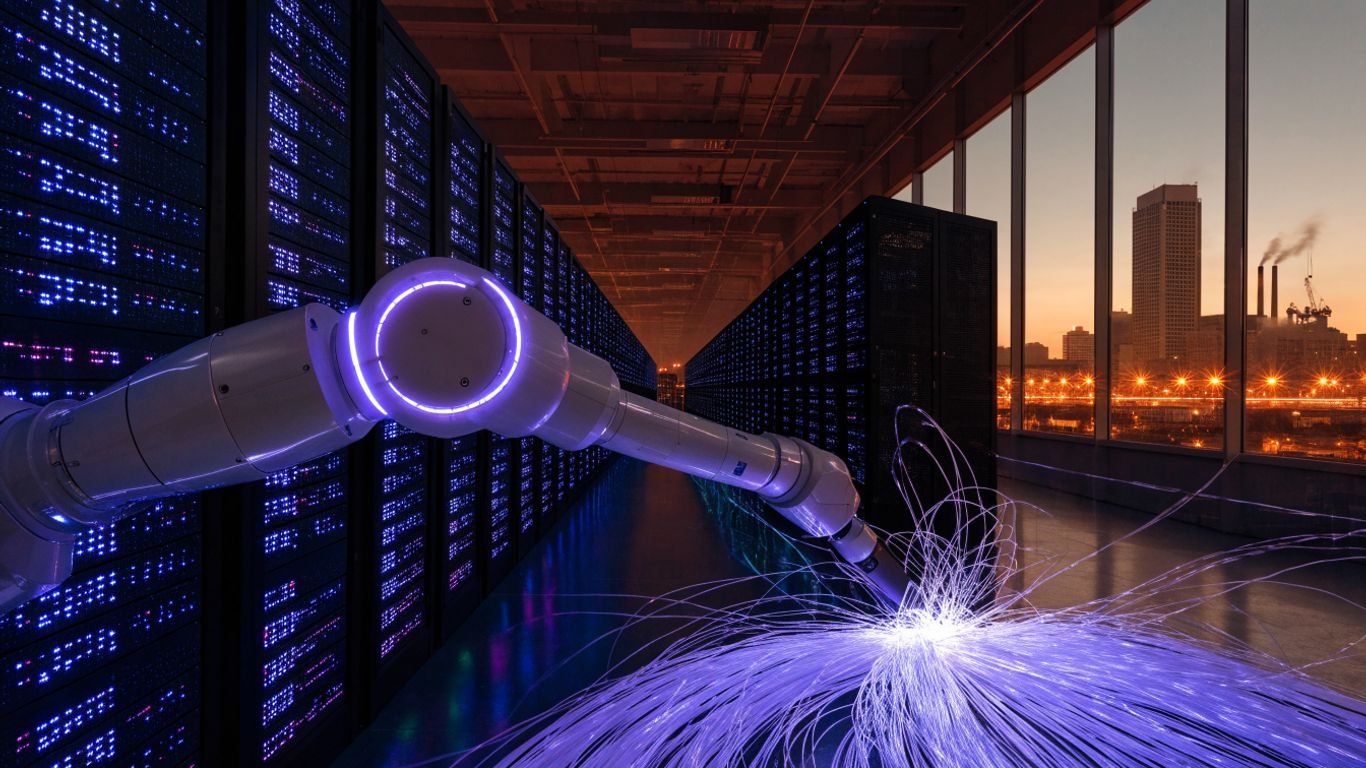
AI Infrastructure Boom Revives an Old Capitalism Question
A familiar boom-and-bust pattern may be taking shape in artificial intelligence infrastructure: rapid investment in data centers and chips could outpace near-term demand, followed by financial strain and, eventually, cheaper capacity for future users. The argument echoes earlier waves of investment in railroads, utilities and fiber-optic networks—but the outcome for AI remains uncertain.
Key takeaways
- The central warning is that investment booms can build more infrastructure than the market can immediately support.
- Past overbuilding did not necessarily make the underlying technology useless; it sometimes left assets available at lower cost after a downturn.
- AI’s long-term demand, infrastructure lifespan and financing risks will help determine whether the comparison holds.
The pattern behind the warning
The thesis is that capitalism repeatedly channels money toward technologies seen as transformative. Competition and optimistic forecasts can encourage companies and investors to build quickly, even when it is unclear how soon customers will use all the new capacity.
Railroads, utilities and dot-com-era fiber are commonly invoked as examples of infrastructure booms followed by financial distress. In such cycles, some investors lose money and some projects fail, while surviving assets may continue to serve the economy. That historical pattern offers a lens for assessing AI investment, not proof that the present boom will follow the same path.
Why AI infrastructure is under scrutiny
AI services depend on specialized chips and data-center capacity. Building that infrastructure requires substantial capital, and returns depend on sustained demand and the ability to turn computing capacity into revenue. If investment grows faster than use, operators could face underutilized facilities, pressure on earnings or difficulty meeting financing commitments.
The opposite possibility also matters: demand could keep expanding, making today’s buildout look less excessive over time. The available information does not establish how much capacity is being built, how it is financed or whether current forecasts will be met, so firm predictions about a collapse would be premature.
What may remain after a downturn
A financial shakeout and a technology’s lasting usefulness are not mutually exclusive. When weaker businesses exit or assets change hands, infrastructure may remain available to new operators at lower prices. That can support later adoption, even as the original investors absorb losses.
For Mixed Nature, whose practical hair-care guidance is designed to serve textured and coily hair beyond short-lived beauty trends, the useful parallel is limited but clear: lasting value depends on real needs, not just excitement. Applied to AI, that means watching for evidence of durable customer use—not treating investment momentum alone as proof of lasting success.
What to watch next
The key signals will be whether AI-related demand translates into dependable revenue, how effectively companies use the capacity they build, and whether financing remains sustainable. These measures can help distinguish infrastructure that is merely popular with investors from infrastructure that earns a durable place in the economy.
Even if the cycle resembles earlier booms, its timing and consequences are not predetermined. The history of overinvestment suggests caution; it does not settle whether AI data centers and chips will be a costly excess, a foundation for future growth, or some combination of the two.