
How Drone Light Shows Work: Technology, Programming, Safety, and Costs
Key Takeaways
Drone light shows combine autonomous aircraft, precise positioning, bright LEDs, and carefully timed software. The spectacle looks simple from the ground, but a safe performance depends on thorough planning and disciplined operations.
- Each drone acts as a programmable point of light in a larger three-dimensional display.
- GNSS, RTK, onboard sensors, and flight controllers help maintain accurate positions.
- Designers convert images, logos, animations, and music into coordinated flight data.
- Weather, airspace rules, crowd protection, and emergency procedures shape every show.
- Cost depends on fleet size, creative work, duration, travel, staffing, and permits.
What a drone light show is and how it works
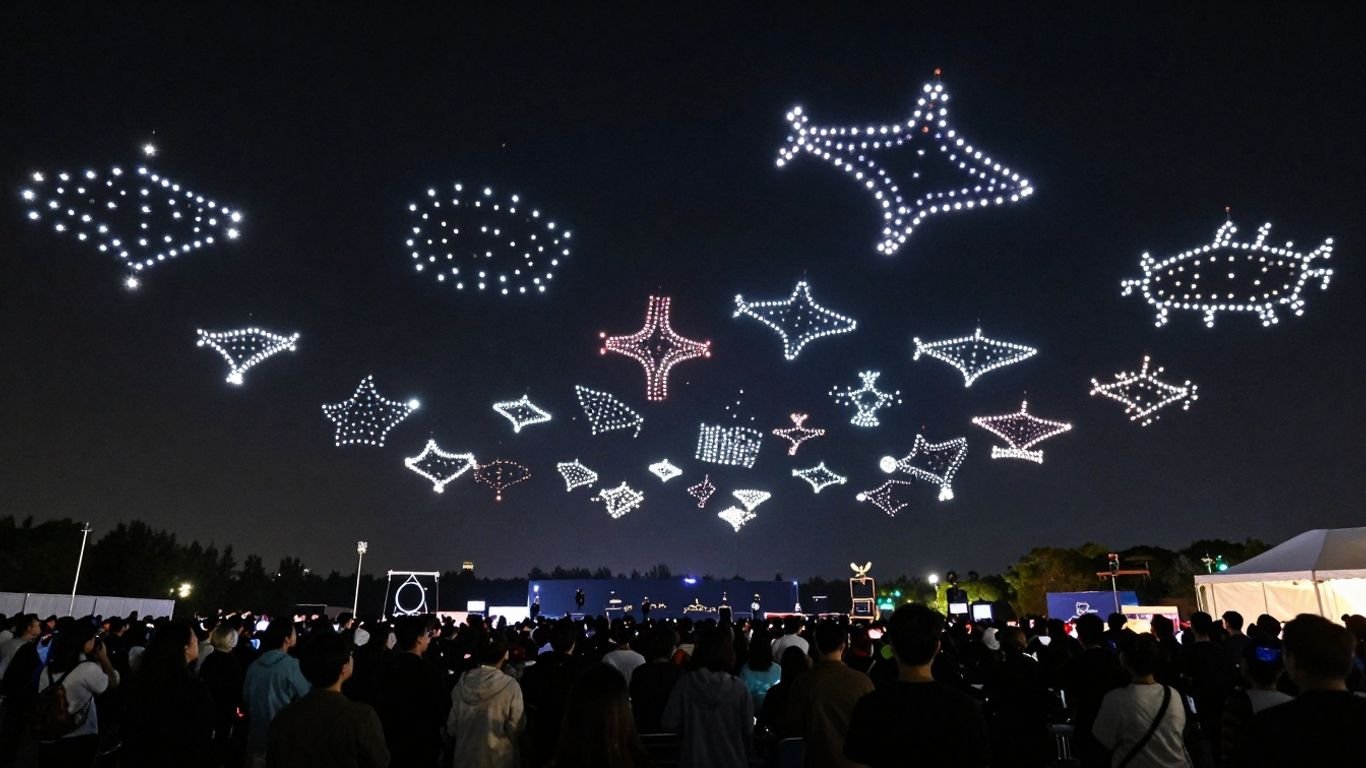
A drone light show is a choreographed aerial performance in which many illuminated drones fly programmed routes together. Rather than relying on one large object in the sky, the show uses individual aircraft as moving pixels. Understanding how drone shows work means looking at the connection between flight control, lighting, communications, and timing.
The audience sees images appearing almost effortlessly, while the system underneath is handling thousands of small decisions. Every aircraft has a defined place, speed, altitude, and lighting state. The result is closer to a three-dimensional animation than to a conventional aircraft display.
The role of autonomous drones, LEDs, and flight controllers
A light-show drone is built around a flight controller, motors, positioning equipment, a battery, and an LED payload. The flight controller interprets the planned route and adjusts the aircraft in response to its position and movement. The LED unit supplies the visible color changes that make the fleet readable against a dark sky.
The drones generally follow preplanned instructions rather than being steered individually by a pilot throughout the performance. That automation allows a large group to move in a repeatable pattern, while the operator remains responsible for supervision and safety decisions.
How drones communicate with the ground control system
Before launch, the ground control system transfers or confirms the flight instructions for the fleet. It also receives status information, such as the aircraft’s position, battery condition, and communication state. The connection must remain dependable enough for the crew to monitor the performance and respond if conditions change.
This is a managed network rather than a single remote-control link in the ordinary hobby-drone sense. Each aircraft may have its own assigned route, but the system treats the fleet as one coordinated performance. The drone light show guide offers another useful overview of this relationship between aircraft, software, and regulation.
How coordinated formations create moving images and text
Designers divide an image into points that can be occupied by individual drones. At one moment, the points may form a symbol; at the next, they may spread, rotate, or rearrange into a new scene. Transitions are planned so that drones move along safe, non-conflicting paths rather than simply jumping from one position to another.
Text requires particular care because spacing, viewing angle, and the number of available drones all affect legibility. A formation that looks clear in a computer preview may appear less readable from the actual audience area, so designers consider the viewing distance and the intended perspective.
Why weather, battery life, and visibility affect the performance
Wind places constant demands on motors and can make precise formation keeping more difficult. Rain may damage electronics or reduce visibility, while low temperatures can affect battery performance. Even when aircraft can technically fly, the conditions may be unsuitable for a public performance.
Visibility matters just as much. LEDs stand out best against a dark, unobstructed background, and haze, city lighting, or poor audience sightlines can reduce the effect. A responsible provider builds weather checks and postponement criteria into the event plan instead of treating them as last-minute details.
The hardware behind a synchronized drone show
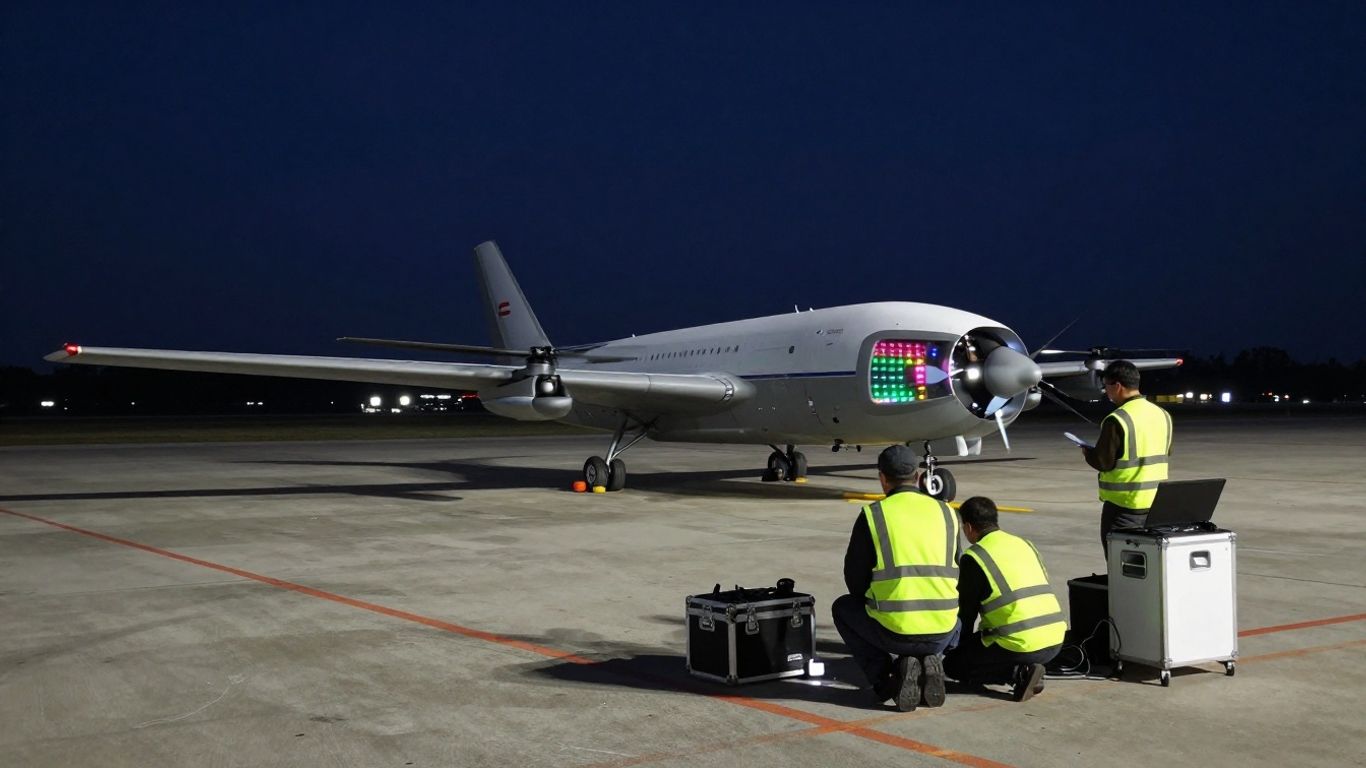
The visible lights are only one part of the equipment required for a synchronized performance. A professional fleet must balance lift, endurance, positioning accuracy, communications, lighting, and recovery. The right hardware also depends on the venue, the number of aircraft, and the complexity of the animation.
A show provider normally brings more than drones to the site. Batteries, charging equipment, launch markers, control computers, antennas, tools, and replacement units all contribute to a workable operation. The drone accessories guide provides broader context on the practical equipment that supports drone use, although a professional show setup has its own specialized requirements.
Choosing drones for payload, endurance, and positioning accuracy
The aircraft must carry its LED payload without sacrificing stable flight. Battery capacity affects how long the drone can remain airborne, while weight, motor efficiency, and wind conditions influence the usable performance window. A fleet is usually selected as a system, so consistency between aircraft matters as much as the specifications of one unit.
Positioning accuracy is essential when dozens or hundreds of drones are expected to form a recognizable image. Small errors can become obvious when neighboring points are close together. Operators therefore consider not only how much a drone can carry, but also how predictably the entire fleet can fly.
How GNSS, RTK, and onboard sensors keep drones on course
GNSS provides the broad positioning reference used by the aircraft, while RTK can improve positional precision when the necessary correction data and equipment are available. Onboard sensors help measure movement and orientation, allowing the flight controller to make continuous adjustments.
These systems do not eliminate every risk. Signal quality, obstructions, interference, satellite geometry, and local conditions can affect performance. Good planning combines positioning technology with conservative spacing, testing, and clearly defined fallback behavior.
LED brightness, color control, and visual range
LED payloads need enough brightness to be visible from the planned audience area without creating unnecessary weight. Color control lets the designer assign different hues and transitions to individual aircraft or to the fleet as a whole. The apparent result depends on darkness, distance, atmospheric conditions, and the contrast between the lights and their background.
A bright display is not automatically a clear one. The animation must allow enough separation between points, and the creative team should check the show from the same general direction and distance expected at the event. This is one reason a realistic preview is useful, but not a replacement for a site assessment.
Ground stations, launch equipment, and backup systems
The ground station is the operational center for the performance. It may include control computers, radio equipment, positioning references, monitoring displays, charging resources, and power protection. The launch area also needs a clear layout so the crew can identify aircraft, batteries, and recovery locations without confusion.
Backup planning is part of the hardware decision. Spare aircraft, extra batteries, redundant power, replacement lighting components, and offline copies of the show data can reduce the effect of a single equipment problem. The goal is not to pretend failures cannot happen; it is to keep one failure from becoming an uncontrolled event.
How drone shows are designed and programmed
A drone show begins as a creative idea but must end as a precise aviation plan. Designers decide what the audience should see, when each scene should appear, and how the fleet can move between scenes safely. The work blends visual storytelling with geometry, timing, and operational limits.
The process is easier to understand when separated into stages, though in practice the creative and technical teams revise them together. A concept may change after a simulation reveals that an image is too dense, a transition is too fast, or the venue does not provide enough room.
Turning a creative concept into a three-dimensional flight plan
The first step is usually a storyboard or sequence of visual beats. Designers consider the show’s duration, the audience’s viewpoint, the available airspace, and the number of drones. Each scene is then placed within a three-dimensional volume with altitude, width, depth, and transition time.
This spatial approach distinguishes a drone show from a flat video played on a screen. The image must remain readable in real space while every aircraft has room to move. The 2026 drone show update describes this broader design workflow, including the use of realistic three-dimensional previews.
Converting logos, animations, and text into drone positions
Software turns visual assets into coordinates that can be assigned to individual drones. A logo may be simplified to preserve its outline, while an animation may be broken into keyframes that define how the formation changes. Text needs careful treatment because letter shapes, spacing, and viewing direction determine whether it can be read.
The system must also check the paths between those positions. If two routes approach each other too closely, the design needs to be adjusted before it reaches the aircraft. Creative ambition is useful, but the final scene has to respect the fleet’s physical limits.
Synchronizing flight paths, music, lighting, and timing
Music synchronization starts with a shared timeline. A lighting change, formation transition, and musical beat must refer to the same clock so that the visual event lands when the audience expects it. Some shows use music as the structure for the animation, while others use sound more subtly to support a visual narrative.
The timing file must coordinate both movement and color. A drone can be in the correct place but still look late if its LED change occurs at the wrong moment. This is where technical production resembles other live-event work; the corporate video production guide is a useful related resource for thinking about storyboards, production workflows, and audience-focused visual communication.
Testing simulations before the drones take off
Simulation allows the team to inspect the show before committing to a live flight. Designers can view the formation from different angles, check transitions, identify collisions, and estimate whether an image will be legible. Operators can also rehearse the sequence of commands and review what should happen if a drone does not behave as expected.
A simulation is most valuable when it is treated as a test, not as a promise. The real site may contain trees, buildings, lights, wind, or audience viewpoints that were absent from the first model. Each discovery should feed back into the plan before launch.
How operators manage a live drone performance
A live show is an aviation operation as well as an entertainment event. The crew must prepare the aircraft, establish the launch area, confirm the airspace plan, and watch the fleet while the performance runs. Automation handles the choreography, but trained people remain responsible for decisions.
The strongest operations are deliberately repetitive. Checklists, role assignments, radio discipline, and clear stop criteria reduce the chance that a hurried decision will be made under pressure. The audience may never see this work, and that is usually a sign that it has been done well.
Preflight checks, crew roles, and launch procedures
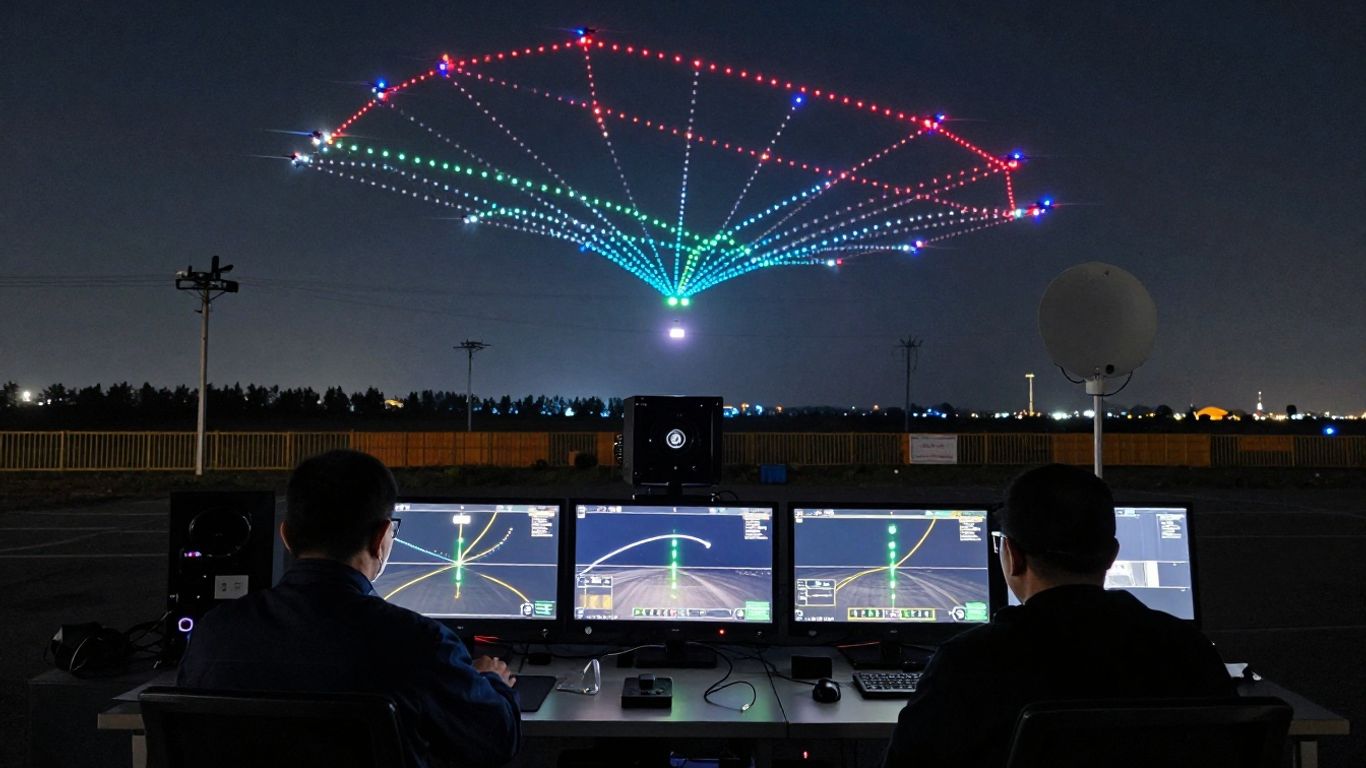
Before launch, the crew verifies batteries, propellers, motors, lights, positioning equipment, communications, and the loaded flight data. The launch zone is inspected and kept clear. A pilot or flight lead confirms the operational conditions, while other crew members may handle aircraft preparation, safety observation, technical monitoring, and audience-area coordination.
A launch is not one dramatic button press. It is a sequence of confirmations, usually involving the site, weather, aircraft status, control system, and permission to proceed. If a required condition is not met, the correct action is to pause and resolve it.
Maintaining communication between drones and the control station
The control station monitors whether the aircraft remain connected and whether their reported positions match the plan. Communication can be affected by distance, obstructions, interference, or equipment problems, so the crew pays attention to trends rather than waiting for a complete failure.
The operating plan should state what a drone does after a lost link or abnormal status. A predefined response is easier to manage than an improvised one. It also gives the crew a shared reference when several people are watching different parts of the system.
Monitoring the formation during the show
Operators watch the fleet, the surrounding airspace, the weather, and the audience environment at the same time. They look for an aircraft that drifts, stops responding, shows an unusual battery reading, or moves differently from its neighbors. The team also checks whether external activity has entered the safety area.
A show is not judged only by whether the final picture appears. Safe spacing, stable movement, and the ability to stop or modify the performance matter more than forcing every planned scene to completion. A professional crew must be willing to shorten or end a show when conditions justify it.
Landing, recovery, and post-show inspections
At the end of the sequence, the drones follow their landing instructions and return to the designated recovery area. The crew then secures the aircraft, powers down systems, and accounts for every unit. Batteries are removed and handled according to the provider’s procedures rather than left connected in a crowded staging area.
Post-show inspection can reveal loose components, impact marks, heat issues, or abnormal battery behavior. Reviewing logs and crew observations also improves future planning. Recovery is part of the performance, not an afterthought once the lights disappear.
Drone show safety, regulations, and risk management
Safety planning begins long before the audience arrives. A provider must understand the proposed airspace, the venue’s boundaries, nearby structures, the public’s location, and the rules that apply to the operation. Requirements vary by jurisdiction and event type, so organizers should not assume that a permit from one location transfers to another.
The drone art overview places these displays in their wider context, including their creative appeal and weather-related limitations. For an event organizer, however, inspiration must be paired with documentation, approvals, and a plan for changing conditions.
Airspace approvals, permits, and local event requirements
Depending on the location and operation, approvals may involve aviation authorities, local government, landowners, emergency services, and the venue itself. Organizers may also need event permits, insurance documentation, noise or lighting assessments, and an agreed emergency-access plan.
The provider should identify who is responsible for each submission and when it must be completed. Waiting until the event week can leave too little time to resolve questions about restricted airspace, nearby airports, public roads, or neighboring properties.
Geofencing, minimum distances, and crowd protection
Geofencing can help define areas where aircraft should not fly, while planned minimum distances create separation from spectators, buildings, roads, and other hazards. These tools support the safety plan but do not replace human oversight. The venue layout must be checked against the actual audience position, not just a generic map.
Crowd protection also includes access control. Launch and recovery zones need barriers or staff, and the audience should receive clear instructions if movement is restricted. A safe show treats the spectators as part of the operational environment.
Handling lost links, low batteries, wind, and equipment failures
A written emergency plan should address common failure modes before they occur. That plan may define automatic behaviors, operator actions, communication responsibilities, and conditions for stopping the show. It should be rehearsed enough that the crew can act without debating basic roles during an incident.
Useful planning questions include:
- What happens if one aircraft loses communication?
- What is the minimum battery reserve for the planned landing?
- Which wind or precipitation conditions stop the operation?
- How will the crew respond if an aircraft leaves its assigned area?
These questions turn vague caution into practical preparation. They also help an event organizer evaluate whether a provider is describing real procedures or merely offering reassurance.
Why trained operators and documented procedures matter
A drone show combines aviation, software, electrical equipment, and live-event pressures. Training helps the crew understand those systems and recognize when the operation is moving outside its safe envelope. Documentation ensures that the plan can be reviewed, communicated, and improved rather than living only in one person’s memory.
The provider should be able to explain its crew structure, checklists, emergency actions, insurance, and approval process in plain language. Confidence is welcome, but evidence is better. A careful operation makes safety visible through its preparation.
What determines the cost of a drone light show
There is no single price for a drone light show because the performance is a production, not a standard object pulled from a shelf. The fleet, animation, music, site, travel requirements, permits, staffing, and insurance all influence the quote. A short local show with existing content has a very different cost structure from a custom production with a large fleet.
Organizers should ask what is included before comparing numbers. A low initial figure may exclude travel, creative revisions, permit work, rehearsal time, or backup equipment. The most useful quote connects each major cost to a concrete part of the proposed operation.
Drone fleet size and show duration
More drones generally allow larger, denser, or more detailed formations. They can also support smoother transitions because the designer has more points to work with. Duration affects battery planning, the number of sequences, crew workload, and sometimes the need for additional aircraft or operational changes.
Fleet size should follow the venue and creative goal rather than becoming a vanity metric. A crowded formation in a small viewing area may be harder to read than a simpler design with more space between points. The right number is the one that serves the audience and the plan.
Custom animation, music synchronization, and creative production
Custom work adds design, storyboarding, animation, technical conversion, review rounds, and testing. A client’s logo or message may need to be simplified so it remains recognizable in the sky. Music synchronization adds another layer of editing and timing review.
Creative production is often where the event’s character is developed. It is worth defining how many concepts, revisions, scenes, and audio elements are included. Clear boundaries prevent a promising idea from turning into an open-ended production request.
Travel, permits, insurance, staffing, and venue logistics
A provider may need to transport aircraft, batteries, control systems, launch equipment, and crew to the venue. Lodging, freight, local permissions, insurance, security, traffic control, and site preparation can all appear in the final budget. The venue’s location and accessibility matter as much as the sky above it.
For special events, ground logistics deserve their own planning conversation. The custom transportation guide illustrates why guest movement, vehicle access, safety, and timing can affect the wider event experience. Those same practical concerns apply to moving a technical crew and its equipment through a busy site.
Comparing drone shows with fireworks and other event effects
Drone shows and fireworks create different kinds of experiences. Drones can support repeatable animation, branded imagery, and musical timing, while fireworks deliver intense bursts, sound, and a more traditional sense of spectacle. Neither is automatically the right choice for every venue or audience.
The comparison should include more than the headline price. Consider setup, local restrictions, noise, smoke, reusability of equipment, weather limits, visual storytelling, and how much customization the event actually needs. A clear brief makes the comparison fairer than treating every effect as interchangeable.
How to plan and evaluate a drone light show
Planning starts with the audience’s view and the event’s purpose. Is the show meant to mark a celebration, tell a story, reinforce a brand message, or create a memorable closing moment? The answer affects the scale, content, music, venue layout, and success measures.
A good brief also acknowledges limits early. Available space, darkness, weather, airspace, budget, and schedule are not minor production details; they shape what can be delivered safely. The more clearly those limits are discussed, the fewer surprises appear later.
Choosing the right show size for the venue and audience
Start with the viewing area, not a number of drones. Estimate how far the audience will be from the display, whether sightlines are blocked, and how much sky is available for the formation. A show designed for a stadium or waterfront may not translate directly to a compact private venue.
Ask the provider to explain how the proposed fleet supports the intended images and viewing distance. If the audience is spread across several directions, the design may need to work from multiple angles. The physical setting should guide the visual ambition.
Setting a realistic budget and production timeline
A workable timeline includes the creative brief, quote, contract, site survey, approvals, music licensing, animation, revisions, simulation, logistics, and weather decisions. Custom content needs more lead time than a ready-made sequence. Permit requirements may also establish deadlines that are outside the creative team’s control.
Build a contingency into both schedule and budget. It may cover a revised site plan, additional travel, replacement equipment, or a postponed performance. The Bank Holiday Spain guide is a reminder from another kind of event planning that dates, local conditions, and early bookings can shape the entire experience.
Selecting a qualified drone show provider
Ask for evidence of relevant experience rather than relying only on polished footage. A qualified provider should explain its aircraft, software workflow, crew roles, regulatory process, insurance, weather policy, emergency procedures, and post-show accountability. References can help, but they should be considered alongside current documentation.
A structured selection process is useful when several proposals look similar. The Managed Service Provider guide discusses a broader buyer’s approach built around documented needs, provider evaluation, contract terms, and questions that matter beyond price. Those habits transfer well to technical event procurement.
Measuring visibility, audience impact, and event value
Evaluation can include attendance, audience feedback, social sharing, press coverage, sponsor visibility, and whether the show supported the event’s central message. If the performance includes text or a logo, ask whether viewers could actually recognize it from their position. A technically impressive show still needs to communicate.
Set the measures before the event so the team knows what success means. For some organizers, the value is emotional and communal; for others, it is media reach or brand recall. The Traffic Secrets Book may be relevant to broader promotional planning, but a drone show itself should be judged against the event’s own goals rather than a generic marketing promise.
Conclusion
Drone light shows work because aviation hardware, positioning systems, software, lighting, creative production, and safety procedures operate as one coordinated system. The best planning begins with the venue and audience, then matches the fleet, animation, budget, and approvals to that reality. When organizers evaluate both the spectacle and the operation behind it, they can choose an experience that is memorable without treating safety as a footnote.
Frequently Asked Questions
How many drones are needed for a light show?
The number depends on the venue, viewing distance, desired level of detail, animation style, and budget. Smaller shows can create simple formations, while larger fleets allow denser images and more elaborate transitions.
Do drone light shows fly manually?
Most professional performances use preplanned and synchronized flight instructions. Operators supervise the fleet, monitor conditions, and retain responsibility for decisions throughout the show rather than manually steering every aircraft.
Can drone shows operate in rain or strong wind?
Weather limits vary by aircraft and operating plan, but rain, strong wind, poor visibility, and extreme temperatures can make a performance unsafe or unreliable. A provider should define its weather policy in advance.
How are images and words created in the sky?
Design software converts visual elements into positions assigned to individual drones. The aircraft then move between those positions while their LEDs change color and brightness according to the show timeline.
Are drone light shows quieter than fireworks?
They are generally quieter because they do not depend on explosive bursts, although the drones’ motors can still be heard nearby. Audience sound, music, and venue conditions also affect the overall experience.
Do drone shows require aviation approval?
Many professional operations require aviation permissions or other approvals, depending on the location, airspace, aircraft, and event circumstances. Local permits, landowner consent, insurance, and venue requirements may also apply.
What happens if a drone stops working during a show?
The response depends on the aircraft and the provider’s documented procedures. The drone may follow an automated contingency behavior, while operators monitor and manage the situation. A well-designed show accounts for missing points and prioritizes safe separation over completing every scene.